A reliable recall is not built by calling your Doodle louder when they are already halfway across a field. It is built by making coming back to you easy, heavily reinforced and worth choosing long before you test it around real distractions.
For most pet dogs, recall is one of the highest-value skills you can teach. It also takes longer than people expect because the environment is competing with you every time you use the cue.
Start with a cue you can protect
Choose a recall word you are comfortable using consistently. “Come,” “here,” or a whistle can all work. The cue itself is not magic; what matters is the history you build behind it.
Try not to use your recall word repeatedly in situations where you already know your dog is unlikely to respond. Every ignored repetition makes the cue less meaningful.
Step 1: build recall indoors
Begin somewhere easy. Call your Doodle from a few feet away when they are already likely to succeed. As they turn toward you, mark the choice with “yes” or your clicker, then reward generously when they reach you.
Do not make every recall end the fun. Call, reward, then release the dog back to whatever they were doing. This teaches that returning to you does not always mean the good stuff disappears.
Step 2: move into the garden
Once the indoor version is easy, practise in a secure garden. Add a little distance, but keep the environment simple.
- Call once
- Move away from your dog rather than chasing them
- Reward when they commit to coming
- Deliver the best reward when they arrive
- Release them again frequently
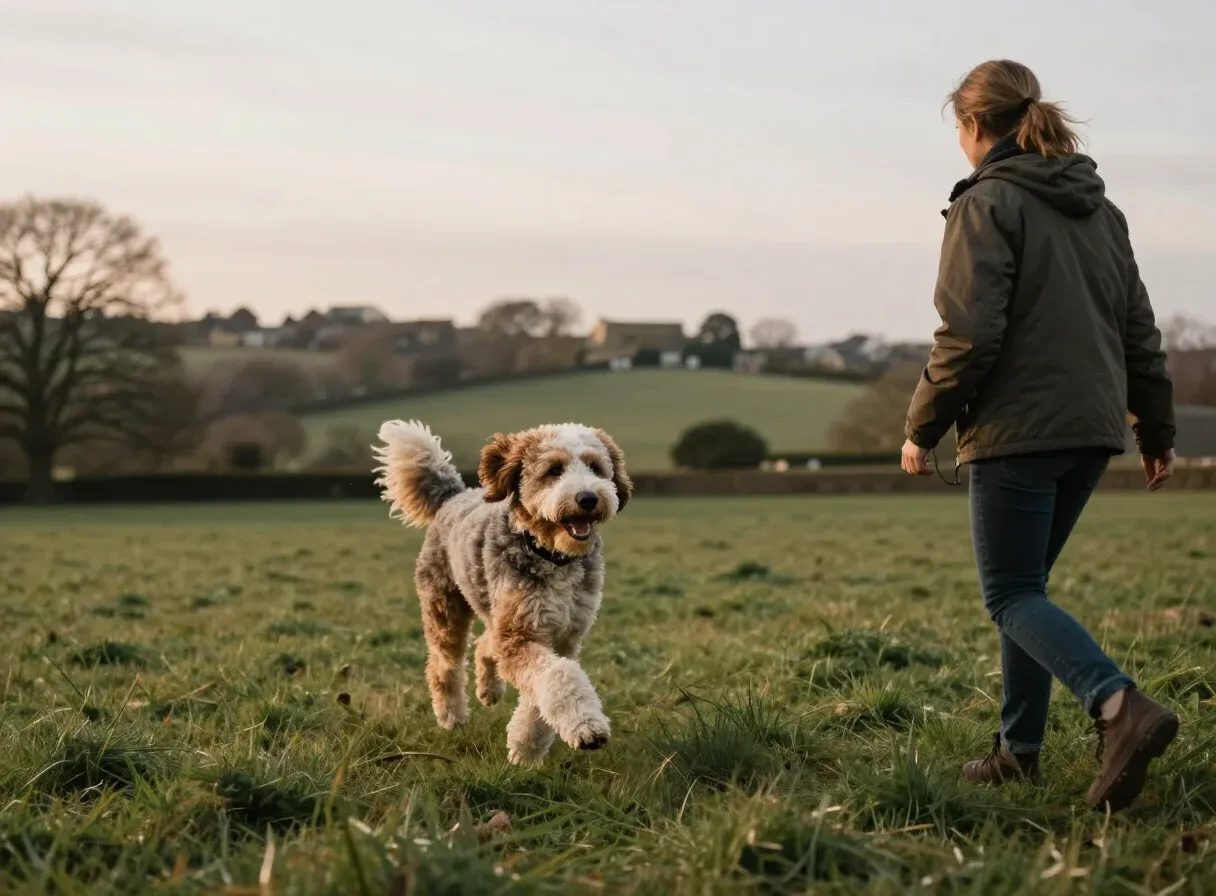
Movement helps. Many dogs find a person jogging backward, crouching or turning into a quick game more compelling than a static human repeating “come.”
Step 3: introduce a long line
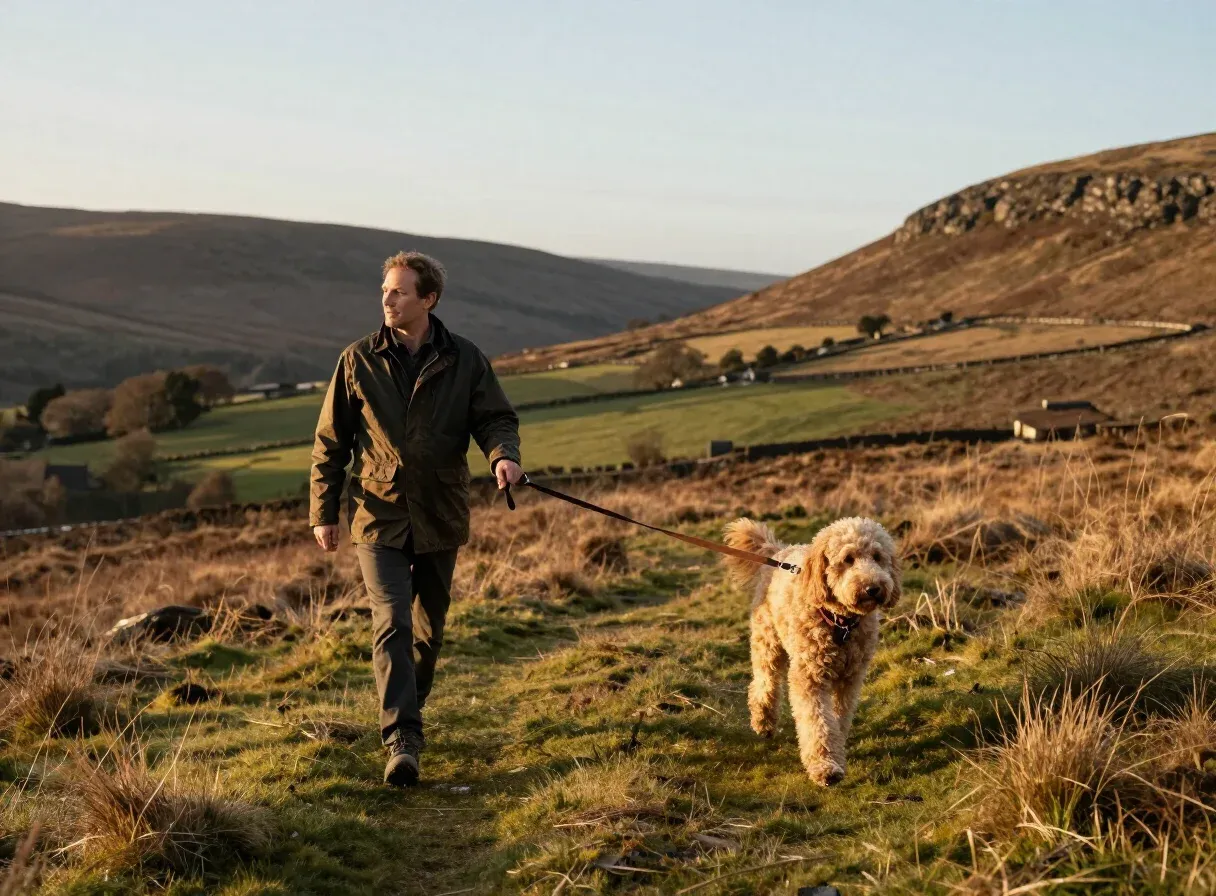
A long line lets you practise in larger spaces without giving your dog the opportunity to disappear or rehearse ignoring you.
Attach it to a well-fitted harness rather than clipping a long line to the neck. If your Doodle hits the end at speed, a harness spreads the load more safely. See our guide to fitting a harness on a deep-chested Doodle.
Let the line trail where safe or hold it loosely. It is a safety system, not a tool for yanking the dog back to you.
Step 4: increase distractions one at a time
Distance is one difficulty. Distraction is another. Do not increase both dramatically at once.
| Stage | Example | Your goal |
|---|---|---|
| Easy | House or quiet garden | Fast, enthusiastic response |
| Moderate | Quiet field on long line | Recall away from sniffing |
| Harder | Field with distant people or dogs | Disengage and return |
| Advanced | Open space with strong real-world distractions | Reliable response without needing the line |
If your Doodle fails, make the next repetition easier. Training is information, not a test of obedience.
What should you reward recall with?
Use rewards that match the difficulty. A piece of ordinary kibble may be enough in the kitchen. Calling away from another dog, rabbit scent or a brilliant patch of mud deserves something more valuable.
- High-value food
- A favourite toy
- A quick game of tug
- Permission to go sniff again
- Running together for a few seconds
The environment itself can be the reward. Call your dog away from a sniff, reward them, then say “go sniff” and let them return. That makes recall part of the fun rather than the thing that always ends it.
The biggest recall mistakes
- Repeating the cue five times
- Calling when you know the dog cannot respond
- Using recall only to end walks or clip the lead on
- Getting angry when the dog eventually comes back
- Moving too quickly from garden practice to off-lead freedom
- Using low-value rewards in high-distraction situations
- Testing recall instead of training it
Never punish the dog who comes back
Even if your Doodle ignored you for thirty seconds first, do not scold them when they finally return. From the dog’s perspective, punishment happened after reaching you. That is exactly the association you do not want.
Secure the dog, make a note that the situation was too difficult, and train an easier version next time.
Should you use a whistle?
A whistle can be excellent because the sound is consistent and carries well outdoors. But it still has to be conditioned.
- Blow the whistle at close range.
- Immediately deliver a fantastic reward.
- Repeat until the sound predicts something excellent.
- Then begin using it for very easy recalls.
- Gradually add distance and distraction just as you would with a verbal cue.
When is your Doodle ready to come off the long line?
I want a substantial history of success first. Your Doodle should be responding in multiple environments, recovering quickly from distractions and showing that they can choose you even when the environment is interesting.
Off-lead freedom is also location-dependent. Wildlife, roads, livestock, local rules and your dog’s individual chase drive all matter. A good recall does not make every environment safe for off-lead exercise.
Loose-lead skills help too. If walks are currently a battle, work through our loose-lead walking plan for Doodles alongside recall.
A 10-minute recall session
- Two easy recalls to warm up.
- Three recalls away from mild sniffing or exploration.
- One slightly harder repetition.
- Two easy recalls again.
- Finish with play or permission to explore.
Stop while your dog is still successful. Five excellent repetitions are more valuable than twenty increasingly sloppy ones.
Frequently asked questions
Why does my Doodle come inside but ignore me outdoors?
Because outdoors is harder. Smells, movement, dogs and wildlife compete with you. Go back to a long line and train at a level where your dog can succeed.
Should I chase my dog if they will not come?
Usually no. Chasing can turn avoidance into a game. Move away, use happy movement, and rely on a long line during training so you do not have to catch the dog.
Can I have two recall cues?
Yes. Many people maintain a normal everyday recall and a highly reinforced emergency cue or whistle. Protect the emergency cue carefully and reward it exceptionally well.