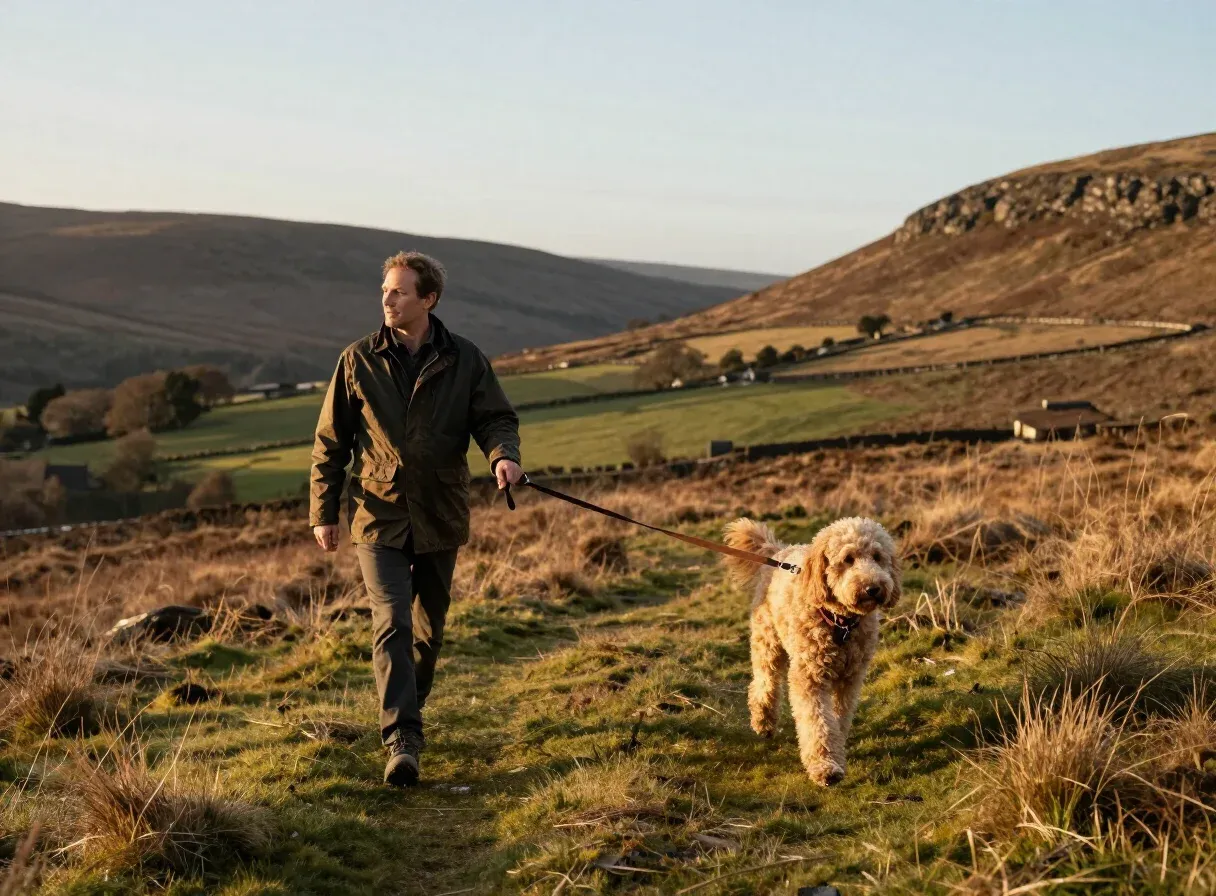
If your Doodle pulls on the lead, the problem usually is not stubbornness, dominance or a dog trying to “be in charge.” Pulling works. It gets dogs toward smells, people, dogs, grass, squirrels and whatever else they want to investigate.
Loose-lead walking is therefore not something most dogs automatically know how to do. It is a skill we teach by making the position and pace we want worthwhile, then practising it in environments where the dog can actually succeed.
Why Doodles pull on the lead
Doodles often combine bright, social, active parent breeds with a lot of enthusiasm for the world around them. That can make lead walking feel chaotic, especially during adolescence.
- The environment is more rewarding than you are. A smell ten feet away may simply matter more than the treat in your pocket.
- Pulling has been reinforced. If pulling gets your dog to the tree, person or dog they wanted, it worked.
- The walk is too difficult. Busy streets, exciting dogs or wildlife can push your Doodle past the point where they can focus.
- Your dog is moving faster than you. Many young dogs naturally travel at a brisker pace than a human stroll.
- They have not learned the actual skill yet. “Walk nicely” is not one behaviour; it is a collection of skills around attention, pace, position and disengagement.
First: check the equipment
I prefer a comfortable, well-fitted harness and a normal fixed-length lead for teaching loose-lead walking. The harness should allow free shoulder movement, sit securely around the ribcage and avoid rubbing behind the front legs.
Because many Doodles are deep through the chest, fit can be awkward. If yours shifts, rubs or restricts movement, see our guide to harnesses that fit deep-chested Doodles.
I would not rely on equipment that hurts, startles or tightens around the neck to stop pulling. Those tools may suppress the pulling in the moment, but they do not teach the dog what to do instead.
How to teach loose-lead walking
Step 1: start somewhere boring
Do not begin this lesson in the middle of your most exciting walk. Start in the house, garden, driveway or another quiet space.
Take a few steps. The moment your Doodle is near you with slack in the lead, mark that moment with a cheerful “yes” or clicker and deliver a reward close to your leg.
Repeat. You are building a simple pattern: staying connected to you while moving makes good things happen.
Step 2: reward before the lead goes tight
One of the biggest mistakes is waiting until the dog is already hauling at the end of the lead, then trying to fix it. Reward the good bit before the mistake.
At first, that may mean rewarding every few steps. That is fine. We can reduce the frequency later, once your dog understands the game.
Step 3: use the environment as a reward
Food is useful, but the environment is often the thing your dog actually wants. You can use that.
If your Doodle wants to sniff a tree, wait for a moment of slack in the lead, mark it, then walk together to the tree. The reward for not pulling is getting to sniff.
This is especially useful for dogs who lose interest in treats outdoors.
Step 4: stop rehearsing full-strength pulling
If your dog reaches the end of the lead, avoid simply being towed forward. Pause, change direction, create a little distance from the distraction or reset the situation so the lead becomes loose again.
The point is not to jerk your dog backward. It is to prevent pulling from being the route to everything they want.
Step 5: increase difficulty gradually
A dog who can walk beautifully in the kitchen may completely forget the skill outside the dog park. That does not mean the training failed. It means the environment became harder.
Increase one thing at a time: duration, distance, distractions or excitement.
| Training stage | Example | What success looks like |
|---|---|---|
| Very easy | House or quiet garden | Frequent check-ins and loose lead |
| Easy | Driveway or quiet street | Can respond to you around mild distractions |
| Moderate | Residential walk | Can recover after smells, people or movement |
| Hard | Busy park or exciting trail | Can remain connected despite high-value distractions |
What to do when your Doodle suddenly lunges toward something
Not all lead pulling is ordinary walking enthusiasm. If your dog is barking, lunging, freezing, staring or becoming frantic around dogs, people or other triggers, you may be dealing with fear, frustration or reactivity rather than a simple loose-lead problem.
In that situation, creating distance matters more than demanding a perfect heel. Get your dog somewhere they can think again, then work below threshold.
How long does loose-lead walking take?
There is no useful universal timeline. A puppy learning in quiet places may improve quickly, while an adolescent Doodle who has spent months practising pulling in exciting environments will need more repetition.
Measure progress by what your dog can do now that they could not do a few weeks ago: more check-ins, longer stretches of slack lead, faster recovery after a distraction and fewer moments of being dragged toward something.
Common loose-lead walking mistakes
- Trying to train only on long, exciting walks
- Waiting until the dog is pulling before rewarding anything
- Expecting the same performance in every environment
- Using rewards that are not valuable enough for the situation
- Marching past every opportunity to sniff
- Confusing loose-lead walking with a competition-style heel
- Increasing distractions too quickly
A simple 10-minute practice session
- Spend two minutes rewarding check-ins while standing still or moving slowly.
- Walk for three minutes in an easy area, rewarding frequently for slack lead.
- Use two or three sniff spots as environmental rewards.
- Practise a few gentle direction changes.
- Finish before your dog is mentally fried.
Short, successful sessions beat one long battle.
If you are also building off-lead skills, pair this work with our guide to teaching reliable recall from the garden to the open field. For new puppies, start with the first 72 hours with your Doodle puppy rather than expecting polished lead walking immediately.
Frequently asked questions
Should I stop every time my Doodle pulls?
You can pause when the lead goes tight, but the bigger goal is to reward often enough that your dog spends more time succeeding than hitting the end of the lead. Prevention is usually more effective than repeatedly correcting the same mistake.
Should my Doodle walk beside me the whole time?
No. For normal pet walks, I want a loose lead, responsiveness and safety. Your dog can still sniff, explore and move around within the available lead length.
Why is my Doodle worse at walking when they see another dog?
Excitement, frustration or fear may make the other dog more important than your training. Increase distance until your Doodle can respond again, then work gradually from there.