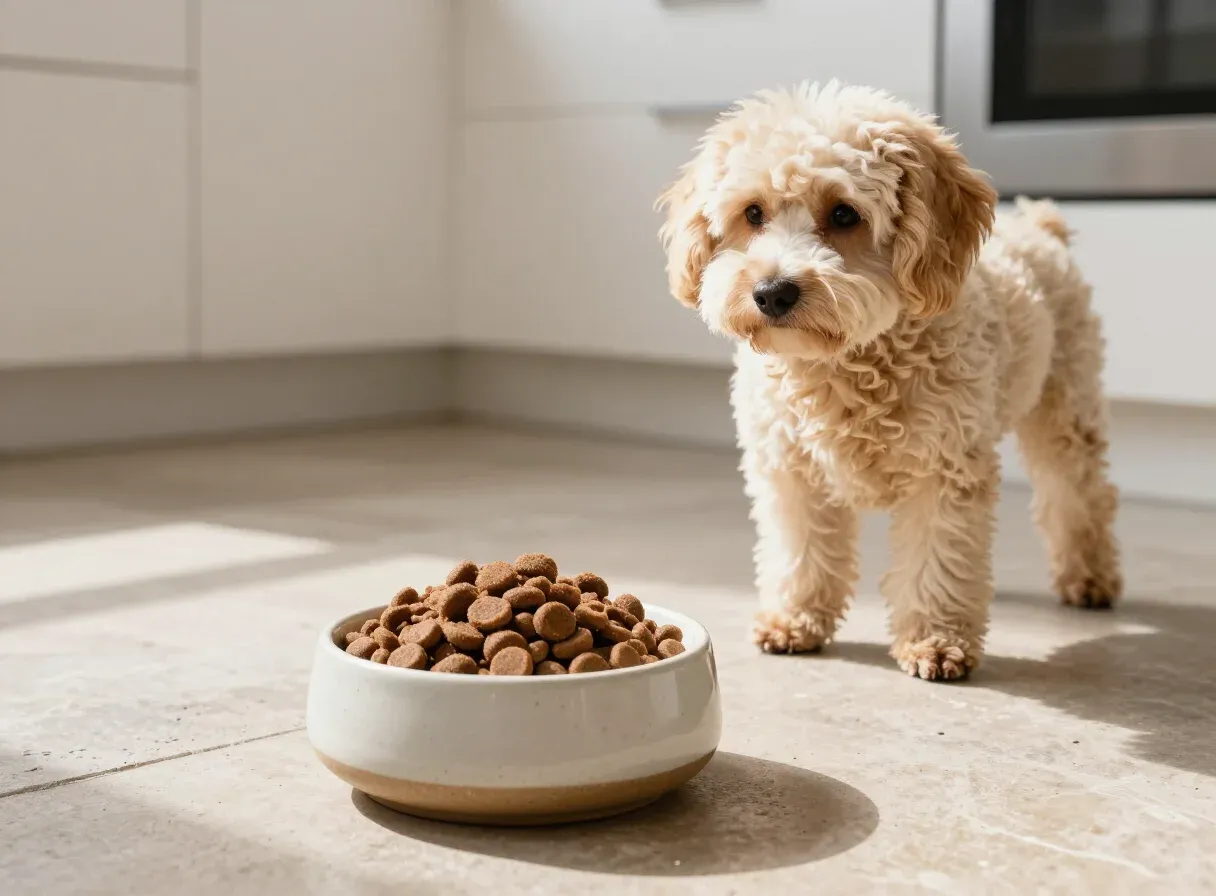
Some Doodles inhale dinner as though another dog is waiting just out of sight to steal it. A slow feeder or food puzzle can stretch mealtime out, but the goal is not to turn eating into an impossible obstacle course.
The best feeder slows your dog enough to chew and engage without creating frustration.
Why slow down a fast eater?
- Meals last longer
- Gulping may reduce
- Food can provide simple enrichment
- You can use part of the daily ration for training or sniffing
- It can turn feeding into a calmer routine
If your dog repeatedly coughs, regurgitates, vomits, seems painful after eating or develops abdominal swelling, do not assume a bowl is the whole answer. Those signs warrant veterinary advice.
Slow feeder vs puzzle feeder vs scatter feeding
| Method | Best for | Watch for |
|---|---|---|
| Slow-feed bowl | Dogs who simply eat too quickly | Design too difficult for muzzle shape |
| Puzzle feeder | Mental engagement with meals | Frustration or chewing the feeder |
| Food toy | Longer licking/chewing sessions | Appropriate size and supervision |
| Scatter feeding | Sniffing and easy enrichment | Use a safe, clean area |
| Training | Building skills from the daily ration | Do not make every calorie hard work |
How difficult should the feeder be?
Easy enough that your Doodle can solve it without becoming frantic.
If your dog paws violently, flips the feeder repeatedly, gives up, guards it, or begins chewing pieces off, simplify the setup.
Enrichment should be enriching. Frustration is not a required ingredient.
Use the normal meal, not extra calories
You do not need to add a mountain of treats to create enrichment. Use part or all of the meal in the feeder and account for extras in the dog’s daily intake.
For the bigger feeding picture, see what a Doodle should actually eat.
Simple mealtime enrichment ideas
- Scatter kibble across a clean patch of grass
- Roll food in a towel for supervised sniffing
- Use a snuffle mat
- Feed from a stuffed food toy
- Use a portion for five minutes of training
- Hide small food piles around one safe room
For puppies, keep it easy
Puppies do not need every meal turned into a cognitive exam. Simple sniffing, easy food toys and tiny training sessions are enough.
If your puppy has just arrived home, predictable feeding may matter more than novelty. Our first 72 hours guide covers those early routines.
What if your Doodle guards food?
Do not repeatedly take the bowl away to “prove” you can. That can make a worried dog more concerned about people approaching food.
If your dog freezes, stiffens, growls or snaps around meals, use management to keep everyone safe and work with a qualified reward-based professional.
How to create a calmer mealtime routine
- Prepare food before your dog becomes frantic.
- Use a feeder appropriate to their skill level.
- Ask for only simple behaviour before placing the meal down.
- Leave the dog in peace while they eat.
- Pick the feeder up after the meal if it is not safe as a chew toy.
You do not need a formal stay while food sits on the floor for two minutes. Calm mealtimes come from predictable routines, not unnecessary frustration.
Frequently asked questions
Are slow feeders good for every dog?
No. Some dogs find particular designs frustrating, and flat-faced or unusually shaped muzzles may struggle with deep grooves. Match the feeder to the dog.
Can I use a muffin tin as a slow feeder?
For some dogs, yes. Simple household setups can work well as long as the material is safe, stable and supervised.
Should my Doodle work for every meal?
No. Enrichment is useful, but eating does not need to be difficult every time. Some meals can simply be meals.